
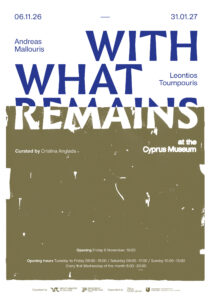
WITH WHAT REMAINS
Andreas Mallouris and Leontios Toumpouris
Curated by Cristina Anglada
Cyprus Museum
Organised by: Department of Antiquities, Deputy Ministry of Culture
Bringing together the work of Andreas Mallouris and Leontios Toumpouris, the exhibition reflects on fragments, reconstruction, memory and care within the context of the Cyprus Museum. With What Remains takes place at a moment of transition for the institution, as it prepares its main collection for a new location and a new architectural and museological framework. Against this backdrop, the artists respond to the Museum’s archaeological exhibits and spaces with site-specific interventions. The exhibition asks what it means to work with what remains: archaeological fragments, damaged objects, bodies, scars, memories, landscapes, stories and forms of knowledge.
The works of Leontios Toumpouris respond to this condition of transition and in-betweenness, treating non-resolution not as a failure to arrive at an endpoint, but as a space for development and speculation. For Toumpouris, the exhibition becomes an open-ended instance: one in which meanings can develop, shift and unfold over time.
In Other departures, more than twenty thousand ceramic fragments, collectively produced in the artist’s studio, refer to imaginary funerary objects, dedicated to bodies that have never been recovered. The work focuses on the invention of vessel fragments through the intensive reproduction of vulnerable components, such as rims and handles, which are often excavated detached from their original vessels. The fragments do not reconstruct what has been lost, but imagine what might have existed, in dialogue with Saidiya Hartman’s concept of critical fabulation: a form of fiction that does not seek to fill the gaps in the archive, but to make visible what the archive cannot recover.
In Progressively forgetting, excavation shifts from the past towards the future. Loosely following methodologies and regulations established by the Department of Antiquities, Toumpouris excavated a small trench in the museum garden with the assistance of Yiannis Christofi, a trained excavation worker with more than fifteen years of experience. The excavation reached the necessary depth to extract subterranean soil potentially carrying dormant seeds, shifting attention from the anthropocentric artefact towards the soil and the land itself. Placed in ceramic flower pots, the soil is subsequently cared for together with members of the museum staff throughout the duration of the exhibition. The work connects with David Abram’s The Spell of the Sensuous and its understanding of the earth as living matter with which we participate and upon which we depend.
In In a collapse, a deliberately incomplete monument, made of steel and ceramics, is installed above the trunk of a dead palm tree at the entrance of the Museum. Activating the remaining cut trunk, the work pays tribute to one of two landmark trees (Phoenix dactylifera) planted outside the Museum in 1914.
Dirt on our tongues transforms the micro-histories of excavation workers into an open-ended, constantly evolving fictional narrative of perseverance, solitude and obsession. The story unfolds progressively throughout the duration of the exhibition, with new chapters periodically printed and installed in stacks for visitors to take and assemble over time.
Across these works, memory ceases to be something that is simply preserved and becomes something that is produced, cared for and imagined.
Andreas Mallouris’s experience as a reconstructive surgeon and his artistic practice come together in an ongoing investigation into the body, its vulnerability and its possibilities for transformation, as well as the poetics of flesh and care. His works bring together hands, tools, bones, flowers, eyes, scars and anatomical fragments: elements that can simultaneously belong to the operating theatre, the artist’s studio or the archaeological site.
In his exhibition cases, instruments and gestures of care and reconstruction are combined with references to the history of medicine and objects that refer to the museum institution itself. One exhibition case centres on the wounded healer, while the second one explores gestures of care and the position of the hand. The amputated thumb of the statue of Asclepius in the Cyprus Museum raises the possibility of reconstructing what is missing through the proposed toe-to-thumb surgical reconstruction. Hands transformed into tools remind us that caring, excavating, healing and preserving are operations that require touch. In another series of assemblages, bronze and wax meet vegetal elements as if holding small rose bulbs, bringing delicacy and anatomy together.
One of the fundamental figures running through Mallouris’s work is Chiron, the centaur who incarnates the paradox of the wounded healer, later formulated by Carl Jung. This idea runs through the artist’s work: those who know the wound from within may develop a particular understanding of the suffering of others, but this knowledge does not necessarily entail the possibility of eliminating their own pain. This figure extends beyond Chiron. In the Byzantine icon of the palpation of Christ’s wound by Saint Thomas, also included here, the wound becomes a means of recognition: Thomas asks to see and touch the wound in order to believe that the figure before him is the resurrected Christ. The wound is therefore not simply evidence of suffering, but also evidence of identity.
The figure of Chiron finds an echo in Philoctetes, abandoned because of the smell of an infected wound. In Mallouris’s work, this myth also becomes a reflection on stigma, illness, marginalisation and the fear of the other’s body. A wound does not only produce pain: it can become that which identifies, separates and excludes.
The scar also becomes a form of memory, an inscription of time upon the body. As Mallouris notes, “outside of the womb all wounds leave scars”; birth itself introduces the body into a condition of vulnerability and transformation.
In this movement between body, matter and care, Mallouris also proposes a way of softening the idea of the institution: introducing what normally falls outside its scope — vulnerability, uncertainty, labour, care and fluid forms of knowledge. The museum, like the body, appears as something that requires attention, repair and responsibility.
With What Remains approaches the museum as a space in which histories can be reconsidered, relationships reconfigured and new forms of knowledge activated. The exhibition asks not only “What survives?” but also “What becomes possible when we choose to work with what remains?”
Supported by Pylon Art & Culture and BA in Fine Art, Department of Design & Multimedia, University of Nicosia.
Exhibition duration: 6 November 2026 – 31 January 2027